I have always been interested in Ham Radio. Back in the day you had to learn Morse code in order to get your license. Fast forward to today and that's no longer a requirement. Nina's dad was a big ham guy and talked to people all over the world. So … with Nina's encouragement I jumped in. I had recently purchased a very nice shortwave radio (Icom IC-R8500) that was produced back in the 1990's. It's in great condition. We were in the middle of Covid and I thought it would be nice to talk to others and see how they were doing.
So I began studing for the exam. On November 23, 2020 I took the Technicians exam and passed that. Then I took the General exam and passed that. The proctor said "why don't you take the amature extra exam – it's no extra cost." So I took the Amature Extra exam and bombed it. So I have a General ham license. My call sign is KJ7SNQ.
I purchased an Icom Ic-7300 and set up shop. My first voice contact was in Japan! I was stoked. I worked voice for a while, but with the sun spots being what they were, and I just had wire end-fed antennas – I decided to try digital. In digital communication your computer sends a signal strength message to your contact. They then send their signal strength message back to you. There are some greeting and good-by messages also, but that's the just of if. This is called FT8. I now have about 5000 contacts in FT8 and have contacted 127 different countries. The great thing about FT8 is that it can operate on very faint transmissions, so I have been able to reach all over the world. One might say what's the big deal – it's just two computers talking back and fourth. There is much more involved that that – you have to make many decisions as to what band, what frequency to transfer from, and getting out a clean transmission signal that can be heard. That kind of simplifies it – there is a lot more involved. I have found it to be a lot of fun.
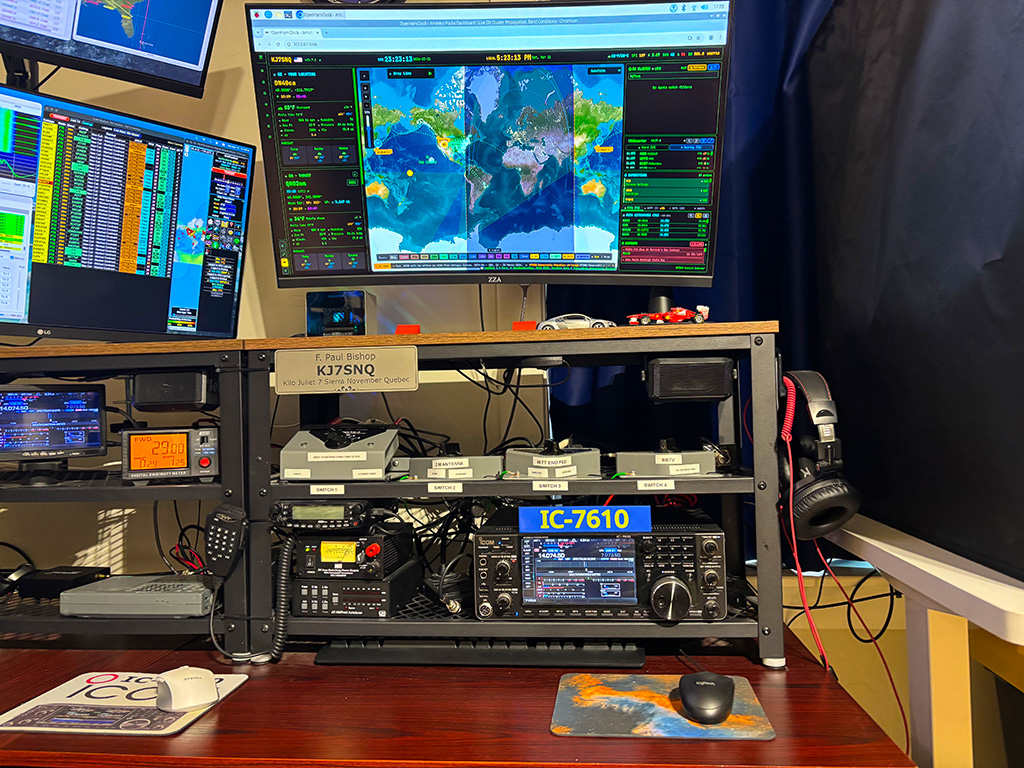
Currently I am working with my Icom IC-7610 transciever. (This is is a high-performance HF/50 MHz all-mode amateur radio transceiver featuring an RF direct sampling SDR system. It provides dual, independent receivers, a 7-inch color touchscreen, a high-speed real-time spectrum scope, and 100 watts of power output.) I have a few antennas. Speaking of antannas – I live in an HOA. That stands for Home Owners Asscociation. They have rules and one of them deals with antennas. They are quite restrictive, so I've had to use my immagination. My main antenna is a Diamond BB7V telescoping antenna that has been working very well for me. It also doubles as a flag. pole. That gets me around the HOA rules. Attached to the BB7V I have a HYS TC-40UV Dual Band VHF UHF 2meter 70cm antenna.
I use the 2 meter antenna on a TVT TH-7800 which is a 50W (VHF) / 40W (UHF) dual-band amateur mobile radio. I also use the 2 Meter antenna on my Icom 8500 shortwave to listen to aviation communiation at the Provo, Spanish Fork, and Salt Lake airports. My dad was an air traffic controller for many years so this is facinating to me.
Finally I have just installed an SDRPlay unit. SDR stands for Software Defined Radio. With this I can listen in on pretty much any band.
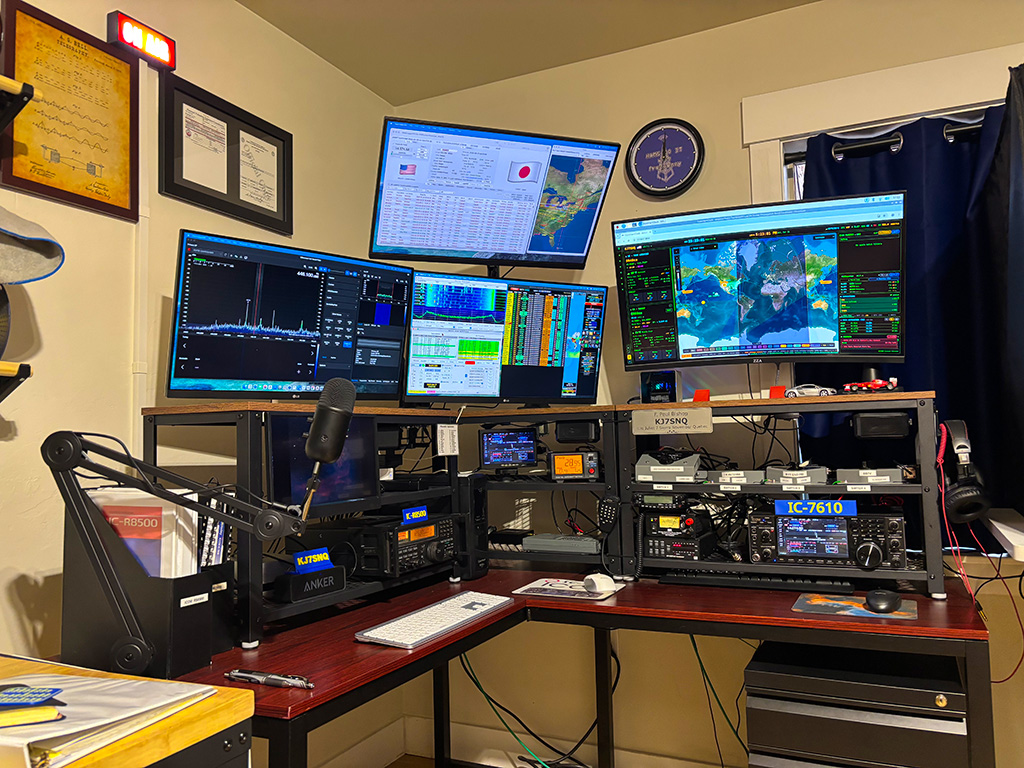
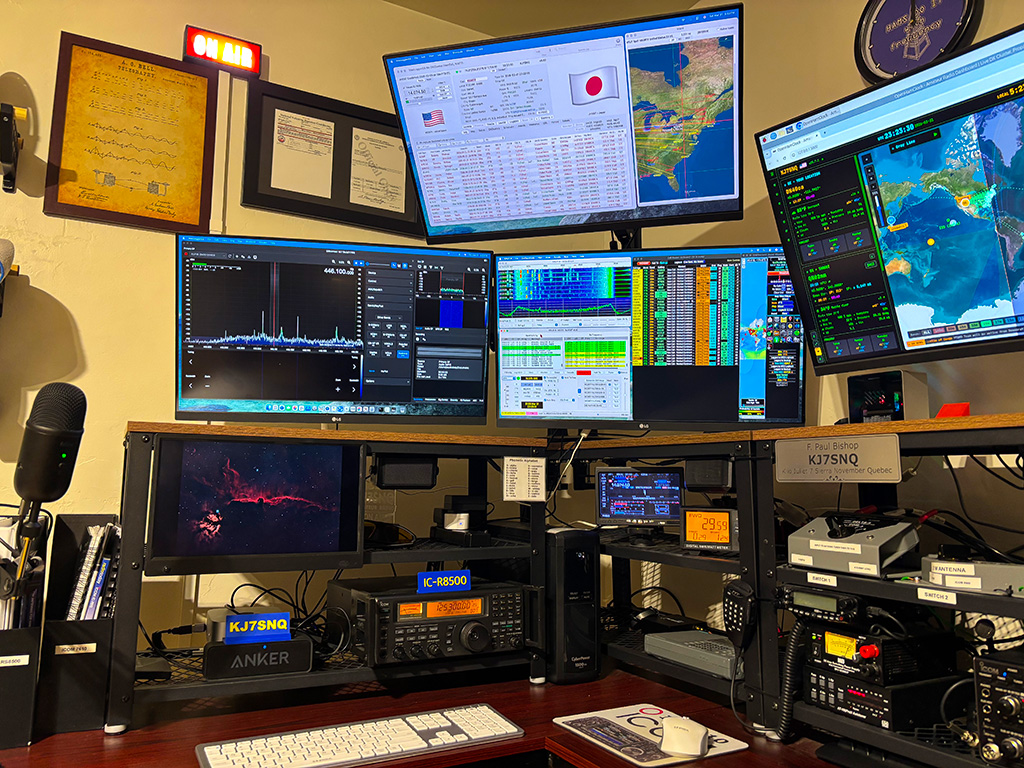
At the bottom I've added some pictures of my "Ham Shack". By way of explination – the monitor on the far right is for Software Defined Radio. The monitor just to it's right displays software showing information about FT8 contacts. The monitor above both of these is my logging software. All of the software is now run by my Mac Mini M4 computer. I used Windows for many years, but got really tired of the frustration and wasted time trying to get Windows 11 to work with all of my software packages. My Mac Mini has worked perfectly since day one, and it really fast! The large monitor on the far right is my OpenHamClock. It is run by a Raspberry Pi 5 computer that is sitting just below the far left edge of this monitor. Oh yes – the small 10 in screen on the lower left (in the last picture) is a digital picture frame that shows some of the images I took with me telescope. That's about it – thanks for looking. If you are still interested the paragraphs below give a little more information about Ham Radio.
Ham radio (amateur radio) is a popular, licensed service used for non-commercial, personal communication, technical experimentation, and emergency support, allowing individuals to connect globally or locally without relying on the internet or cell phones. Its key aspects include emergency preparedness, worldwide communication, and experimental technology, offering a relevant, modern hobby in a digital age.
Purpose of Ham Radio
Emergency Communications: It serves as a vital, independent lifeline during natural disasters (like hurricanes or tornadoes) when traditional phone/internet infrastructure fails.
Technical Education & Experimentation: It encourages learning about electronics, radio propagation, and physics.
Public Service: Operators support communities by facilitating communications for public events like marathons and parades.
Social Connection: It connects people globally, fostering friendships across cultures and borders.
Key Aspects & Capabilities
Independence from Infrastructure: Operating on dedicated radio frequencies, ham radio does not rely on commercial cellular networks.
Versatile Communication Modes: Operators use voice, Morse code (CW), and modern digital modes to transmit data.
Licensing & Regulation: Operators must pass examinations regulated by the FCC (in the US) to obtain licenses (Technician, General, or Amateur Extra).
Wide Range of Activity: Activities include satellite communication, “fox hunting” (radio direction finding), and “contesting” to contact as many stations as possible.
Modern Appeal
Digital Integration: Ham radio has evolved, with technologies like FT8 (digital mode) and digital voice modes allowing interaction with computers and the internet.
Resilience in Crisis: It remains the most reliable communication tool when modern, high-tech systems fall silent, proving its necessity to a new generation.
Experimental Freedom: It attracts makers and technology enthusiasts interested in building antennas, designing circuits, and utilizing software-defined radios (SDR).
Community Support: Local clubs and global, non-commercial networks provide a strong sense of community and mentorship.
For those looking to get started, organizations like the American Radio Relay League (ARRL) provide extensive resources.